
William Cunningham
Historical Theology
Vol. 2, pp. 154-160.
In the rationalistic perversion of the true principles of the Reformation, as to the investigation of divine truth and the interpretation of Scripture, we have the foundation on which Socinianism [i.e. Unitarianism] is based—namely, the making human reason, or rather men’s whole natural faculties and capacities, virtually the test or standard of truth; as if the mind of man was able fully to take in all existences and all their relations, and as if men, on this ground, were entitled to exclude, from what is admitted to be a revelation from God, everything which could not be shown to be altogether accordant with the conclusions of their own understandings, or thoroughly comprehensible by them.
In regard to this principle, and the general views of theology, properly so called, which have resulted from its application, it is not always easy to determine whether the application of this peculiar principium theologiae produced the peculiar theology, or the peculiar theology, previously adopted from some other cause, or on some other ground, led to the maintenance of the peculiar principium, as the only way by which the theology could be defended. If men had adopted rationalistic principles as their rule or standard in the investigation of divine truth and the interpretation of Scripture, they would certainly bring out, in the application of them, the Socinian system of theology; and, on the other hand, if, from any cause or influence, they had already imbibed the leading elements of the Socinian system of theology, and yet did not think it altogether safe or expedient to deny the divine origin of the Christian revelation, they must, as a matter of course, be forced to adopt, as their only means of defence, the rationalistic principle of interpretation. These two things must, from the very nature of the case, have always gone hand in hand. They could scarcely, in any case, be separated in the order of time; and it is of no great importance to determine, in particular cases, which may have come first in the order of nature—which was the cause, and which the effect.
Papists Accuse The Reformation As The Cause of The Socinian Heresy.
Papists allege that Socinianism was one of the consequences of the Reformation—of the unrestrained and licentious speculations upon religious matters which they ascribe to that important event. The principles on which the Reformers acted, and on which the Reformation was based, were not the causes of, and are not responsible for, the errors and heresies which have sprung up in the Reformed churches. At the same time, it cannot be disputed, that the Reformation tended to introduce a state of society, and a general condition of things, which led to a fuller and more prominent development of error, as well as of truth, by giving freedom of thought, and freedom in the expression of opinion. In the Church of Rome, and in countries that are fully under its control, the maintenance of any other errors and heresies than those which that church sanctions, is attended with imminent danger, and leads to sacrifices which few men are disposed to make, even for what they may regard as true.
This was the condition of Christendom before the Reformation. It lay wholly under the domination of a dark and relentless despotism, the tendency and effect of which were, to prevent men from exercising their minds freely upon religious subjects, or at least from giving publicity to any views they might have been led to adopt, different from those which had the civil and ecclesiastical authorities on their side. Wherever the Reformation prevailed, this state of matters gradually changed. Despotism gave place to liberty. Liberty was sometimes abused, and this led to licentiousness. But it is not the less true that liberty is preferable to despotism, both as being in itself a more just and righteous condition of things, and as being attended with far greater advantages, and with fewer and smaller evils.
The Origin of Socinianism.
With respect to Socinianism in particular, there is much in the history of its origin, that not only disproves the Popish allegation of its being traceable to the principles of the Reformation, but which tends to throw back upon the Church of Rome a share, at least, of the responsibility of producing this most pernicious heresy. The founders of this sect were chiefly Italians, who had been originally trained and formed under the full influence of the Church of Rome. They may be fairly regarded as specimens of the infidelity—or free-thinking, as they themselves call it—which the Popish system, in certain circumstances, and in minds of a certain class, has a strong tendency in the way of reaction to produce. They were men who had come, in the exercise of their natural reason, to see the folly and absurdity of much of the Popish system, without having been brought under the influence of truly religious impressions, or having been led to adopt a right method of investigating divine truth.
They seem to have been men who were full of self-confidence, proud of their own powers of speculation and argument, and puffed up by a sense of their own elevation above the mass of follies and absurdities which they saw prevailing around them in the Church of Rome; and this natural tendency of the men, and the sinful state of mind which it implied or produced, were the true and proper causes of the errors and heresies into which they fell. Still it was the Church of Rome, in which they were trained, and the influences which it brought to bear upon them, that, in point of fact, furnished the occasions of developing this tendency, and determining the direction it took in regulating their opinions.
The irrational and offensive despotism which the Church of Rome exercised in all matters of opinion, even on purely scientific subjects, tended to lead men who had become, mentally at least, emancipated from its thraldom, first and generally, to carry freedom of thought to the extreme of licentiousness; and then, more particularly, to throw off the whole system of doctrine which the Church of Rome imposed upon men, without being at much pains to discriminate between what was false in that system, and what might be true. This is, indeed, the true history of Socinianism—the correct account of the causes that in fact produced it.
Socinus’ Monstrous Questions & Skepticism.
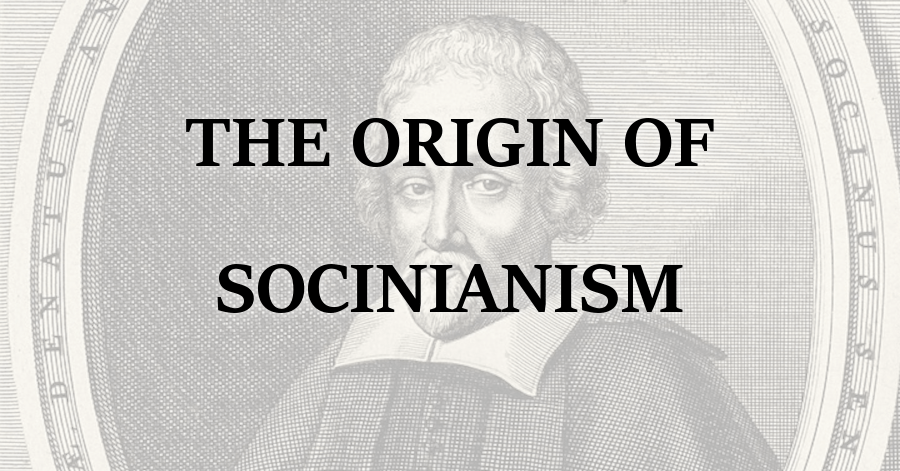
Laelius Socinus (1525-1562), who is usually regarded as the true founder of the system—though his nephew, Faustus (1539-1604), was the chief defender and promulgator of it—seems to have formed his opinions upon theological subjects before he was constrained to leave Italy, and take refuge among the Protestants, where somewhat greater freedom of opinion was tolerated. He did not certainly find among the Reformers, with whom he came into contact, anything to encourage him in the theological views which he had imbibed; but neither was he brought, by his association with them, under any of those more wholesome influences, which would have led him to abandon them, and to embrace the great doctrines of the Reformation.
He continued to manifest the same tendency, and the same disposition, which he had exhibited in Italy; and he retained the theological views which, in substance, he seems to have formed there. So that, though he published little or nothing, and did not always very fully or openly avow his peculiar opinions, even in private intercourse, yet, as there is reason to believe that he was really and substantially the author of the system afterwards developed and defended by his nephew, his history is truly the history of the origin of the system; and that history is at least sufficient to show, that Popery is much more deeply involved in the guilt of producing Socinianism than Protestantism is.
Calvin & Zanchi’s Responses To Socinus.
It may be worth while, both as confirming the views now given of the character and tendencies of Laelius Socinus, and also as illustrating the method often adopted by such men in first broaching their novel and erroneous opinions, to give one or two specimens of what the Reformers with whom he came into contact have said regarding him. He carried on for a time a correspondence with Calvin; in which, while he does not seem to have brought out distinctly the theological views afterwards called by his name, he had so fully manifested his strong tendency to indulge in all sorts of useless and pernicious speculations, as at length to draw from that great man the following noble rebuke:
“You need not expect me to reply to all the monstrous questions (portenta quaestionum) you propose to me. If you choose to indulge in such aerial speculations, I pray you suffer me, a humble disciple of Christ, to meditate on those things which tend to the edification of my faith [cf. 1 Tim. 1:4]. And I indeed by my silence will effect what I wish, viz., that you no longer annoy me in this way. I am greatly grieved that the fine talents which the Lord has given you, should not only be wasted on things of no importance, but spoiled by pernicious speculations. I must again seriously admonish you, as I have done before, that unless you speedily correct this itching after investigation (quoerendi pruritum), it may bring upon you much mischief. If I were to encourage, under the appearance of indulgence, this vice, which I believe to be injurious, I would be acting a perfidious and cruel part to you; and, therefore, I prefer that you should now be somewhat offended by my asperity, than that I should abstain from attempting to draw you away from the sweet allurements of the curiosity (or love of curious speculation) in which you are entangled. The time, I hope, will come, when you will rejoice that you were awakened from it, even by a rude shock.” (cf. John Calvin, Tracts & Letters vol. 5, pp. 330-1).
Zanchius, too, was an Italian, and, like Socinus, had fled from that country, because it was not safe for him to remain there, in consequence of the anti-Papal views which he had adopted. Put then, unlike Socinus, he was a sincere and honest inquirer after truth. he had sought and obtained the guidance of the Spirit of God. He had studied the Bible, with a single desire to know what God had there revealed, that he might receive and submit to it. And he had in this way been led to adopt the same system of theology as Calvin and the other Reformers, and proved himself an able and learned defender of it. In the preface to his work on the Trinity, De Tribus Elohim (1572), he thus describes Socinus:
“he was of a noble family, well skilled in Greek and Hebrew, and irreproachable in his outward conduct; and on these accounts I was on friendly terms with him. But he was a man full of diverse heresies, which, however, he never proposed to me, except, as it were, for the purpose of disputation, and always putting questions as if he wished for information. And yet for many years he greatly promoted the Samosatanian heresy, and led many to adopt it.”
Such was the origin of Socinianism, and such, to a large extent, has been the kind of men by whom it has been advocated, although many of them have been fortunate enough to find themselves in circumstances that rendered it unnecessary to have recourse to the policy and management which its founder adopted, as to the mode of bringing out his opinions.
cf. Socinianism | Reformed Forum (22 Nov. 2019)
 Purely Presbyterian