
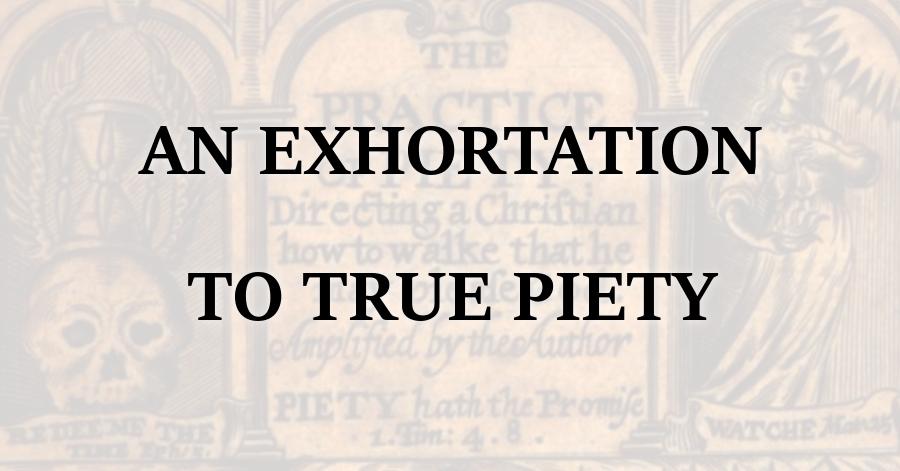
Lewis Bayly,
The Practice of Piety, pp. 98-101.
Forasmuch as you see that without Christ you are but a slave of sin, death’s vassal, and the food of worms, whose thoughts are vain—whose deeds are vile—whose pleasures have scarcely a beginning—whose miseries never know end: what wise man would incur these hellish torments, though he might, by living in sin, purchase to himself for a time the empire of Augustus, the riches of Croesus, the pleasures of Solomon, the policy of Ahithophel, the voluptuous fare and fine apparel of the rich man? For what should it avail a man, as our Savior says, to win the whole world for a time, and then to lose his soul in hell forever?
And seeing that likewise you see how great is your happiness in Christ, and how vain are the hindrances that debar you from it; beware, as the apostle exhorts, of the deceitfulness of sin (Heb. 3:13); for that sin, which seems now to be so pleasing to your corrupt nature, will one day prove the bitterest enemy to your distressed soul, and in the meanwhile harden, unawares, your impenitent heart.
Sin, as a serpent, seems beautiful to the eye, but take heed of the sting behind, whose venomous effects, if you knew, you would as carefully fly from sin as from a serpent. For,
1. Sin did never any man good: and the more sin a man has committed, the more odious he has made himself to God, the more hateful to all godly men.
2. Sin brought upon you all the evil, crosses, losses, disgraces, and sicknesses, which ever befell you: “Fools;” says David, “by reason of their transgressions, and because of their iniquities, are afflicted.” (Psalm 107:17). Jeremiah in a lamenting manner asks the question, “Why is the living man sorrowful?” (Lam. 3:20). The Holy Spirit answers him, “Man suffers for his sin.” Hereupon the prophet takes up that doleful outcry against sin, as the cause of all their miseries, “Woe now unto us that ever we have sinned!” (Lam. 5:16).
3. If you do not speedily repent you of your sins, they will bring upon you yet far greater plagues, losses, crosses, shame, and judgments, than hitherto ever befell you (Lev. 26:18ff.; Deut. 28:15ff.).
4. And lastly, If you will not cast off your sin; God, when the measure of your iniquity is full, will cast you off for your sin (Gen. 15:6); for as he is just, so he has power to kill and cast into hell all hardened and impenitent sinners. If, therefore, you will avoid the cursed effects of sin in this life, and the eternal wrath due to it in the world to come, and be assured that you are not one of those who are given over to a reprobate mind; let then, O sinner, my counsel be acceptable unto you! break off your sins by righteousness. O let there at length be an healing of your error! (Dan 4:27). Nathan used but one parable, and David was converted (2 Sam. 12:13); Jonah preached but once to Nineveh, and the whole city repented (Jonah 3:5); Christ looked but once on Peter, and he went out and wept bitterly (Luke 22:62). And now that you are oft and so lovingly entreated, not by a prophet, but by Christ the Lord of prophets; yes, that God himself, by his ambassadors, begs you to be reconciled to him (2 Cor. 5:20), leave off your adultery with David; repent of your sins like a true Ninevite; and while Christ looks in mercy upon you, leave your wicked companions, and weep bitterly for your offenses.
Content not yourself with that formal religion which unregenerate men have framed to themselves, instead of sincere devotion; for in the multitude of opinions, most men have almost lost the practice of true religion. Think not that you are good enough, because you do as the most, and are not so bad as the worst. No man is so wicked that he is addicted to all kind of vices, for there is an antipathy between some vices; but remember that Christ says, “Except your righteousness shall exceed the righteousness of the scribes and Pharisees, you shall in no case enter into the kingdom of heaven.” (Mat. 5:20). Consider with yourself how far you come short of the Pharisees, in fasting, praying, frequenting the church, and giving of alms: think with yourself how many pagans who never knew baptism, yet in moral virtues and honesty of life, do go far beyond you—where is then the life of Christ your master? And how far are you from being a true Christian?
If you do willingly yield to live in any one gross sin, you can not have a regenerate soul, though you reform yourself, like Herod, from many other vices. A true Christian must have respect to walk, in the truth of his heart, in all the commandments of God alike (Mark 6:20:) “For,” says James, “he who shall offend in one point of the law” (willfully) “is guilty of all.” (James 2:10). And Peter bids us lay aside, not some, but “all malice, guile, and hypocrisies,” etc. (1 Pet. 2:1). One sin is enough to damn a man’s soul, without repentance. Dream not to go to heaven by any nearer or easier way than Christ has trained unto us in his word: the way to heaven is not easy or common, but straight and narrow (Mat. 7:14); yes, so narrow, that Christ protests that a rich man shall hardly enter into the kingdom of heaven (Mat. 19:23), and that those that enter are but a few (Mat. 7:14; 22:14), and that those few cannot get in but by striving (Luke 13:24), and that some of those who strive to enter in shall not be able. This all God’s saints, while they lived here, knew well; when with so often fastings, so earnest prayers, so frequent hearing the word, and receiving the sacraments, and with such abundance of tears they devoutly begged at the hands of God, for Christ’s sake, to be received into his kingdom.
If you will not believe this truth, I assure you that the devil, who persuades you now that it is easy to attain heaven, will tell you hereafter that it is the hardest business in the world. If, therefore, you are desirous to purchase sound assurance of salvation to your soul, and to go the right and safe way to heaven, get forthwith, like a wise virgin (Mat. 25:1), the oil of piety in the lamp of your conversation, that you may be in a continual readiness to meet the bridegroom, whether he comes by death or by judgment.
 Purely Presbyterian